

Bird Vision, Focus and Light Levels
Increasing the Risk of coming to harm with Electricity
In the article "Not so eagle eyed: New study reveals why birds collide with human-made objects." ScienceDaily. ScienceDaily, 17 March 2011 Wiley-Blackwell, Dr Graham Martin from Birmingham University explains how birds live in a different visual world to humans. " A bird is a wing guided by an eye" he explains as avian frontal vision is more geared to movement, in the absence of which a bird is more likely to be looking downwards or sideways. Thus detection of objects in the flightpath if often even more hampered, in addition to the in darkness, rain, mist or fog.

drawing from The National Eagle Centre, Wabasha, Minnesota, USA
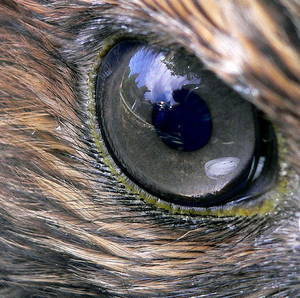
photo of a Hawk's Eye by Steve Juvetson
Another study by Scientists from the Centre for Ornithology at the University of Birmingham, UK, studied three particularly affected species: kori bustards (Aerdeotis kori) blue cranes (Anthropoides paradisea) and white storks (Ciconia ciconia). Their findings, published in the journal Biological Conservation, identify that these species share significant blind areas to the front of their heads. Although the heavy bustard differs greatly in general body shape from the delicate crane and stork, the birds share a foraging technique - visually guiding their bill to take food items. This technique requires excellent vision at the end of the bill, resulting in a narrow field of vision and wide "blind spots".
In a BBC interview for 'Earthnews' Professor Graham Martin commmented:
"Once we saw the wisdom of looking at the problem through birds' eyes rather than human eyes, it all made sense".
"These birds can see straight ahead in flight but they only need to pitch their heads forward by a small amount and they will be blind in the direction of travel."
Many species of bird have been observed looking down during flight, possibly to locate fellow birds and suitable foraging and nesting sites.
Narrow binocular fields combined with birds' tendencies to look down effectively means certain species cannot see power lines until it is too late.
"Not all birds will be blind ahead when they look down but we can certainly suggest that this will apply in all crane and bustard species and probably in larger raptors including eagles and vultures," Professor Martin tells the BBC.(eg birds of prey scanning for prey, cranes or geese looking down at others flying in formation)
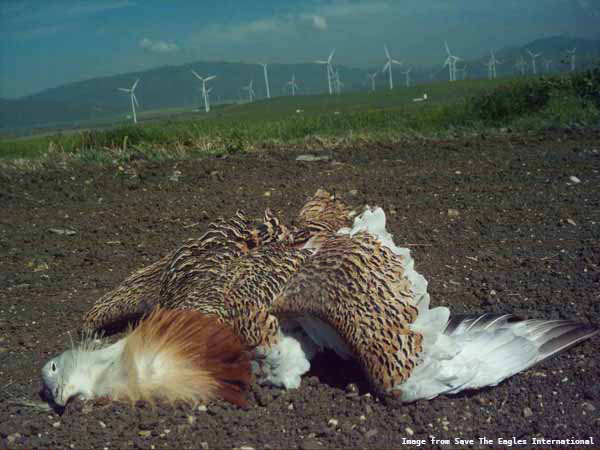
'Jorge', the last great bustard in Cadiz region, killed by turbines or power lines
Birds particularly at risk are larger birds such as Swans, Storks and Flamingos and also birds of prey.
The impact of collision, along with electrocution, can completly threaten a species towards extinction as is the case with many Storks, Eagles and Vultures.

Killing Ground: Mass electrocution of Flamingos on Khadir Island, Gujarat
Photo R.D.Meriya: 8am November 20, 2011